When configuring QoS (Quality of Service) in Microsoft Lync / Skype for Business you need to modify the media port ranges for various Services and Configuration using PowerShell.
Pat Richard has made a brilliant QoS calculator for Lync/Skype for Business here http://www.ehloworld.com/2821. The calculator will provide you with the PowerShell commands required to configure QoS port ranges and the GPO’s. The calculator also gives you the commands to verify the Configuration (which this post is based on).
I needed to verify the QoS configuration on a customers environment with multiple pools. The PowerShell script below will run all of the verify commands in Pat’s script against all pools.
Write-Host "Client P2P Ports - Ignore ClientSipDynamicPort/Range and ClientMediaPort/Range values" -ForegroundColor DarkYellow
Get-CsConferencingConfiguration -Identity global | Format-List Identity,*port*

Write-Host "Conferencing Server Ports" -ForegroundColor DarkYellow
Get-CsService -ConferencingServer | Format-List Identity,AppSharingPortStart,AppSharingPortCount,AudioPortStart,AudioPortCount,VideoPortStart,VideoPortCount

Write-Host "Application Server Ports" -ForegroundColor DarkYellow
Get-CsService -ApplicationServer | Format-List Identity,AppSharingPortStart,AppSharingPortCount,AudioPortStart,AudioPortCount,VideoPortStart,VideoPortCount

Write-Host "Mediation Server Ports" -ForegroundColor DarkYellow
Get-CsService -MediationServer | Format-List Identity,AudioPortStart,AudioPortCount

Write-Host "QOS Enabled" -ForegroundColor DarkYellow
Get-CsMediaConfiguration -Identity global | Format-List Identity,EnableQoS

Write-Host "Edge Server Ports - Best practice to leave default start port 50,000, count 10,000" -ForegroundColor DarkYellow
Get-CsService -EdgeServer | Format-List Identity,MediaCommunicationPortStart,MediaCommunicationPortCount

Write-Host "Web Server Application Server Ports" -ForegroundColor DarkYellow
Get-CsService -Webserver | Format-List Identity,AppSharingPortStart,AppSharingPortCount

Write-Host "Lync Phone Edition DSCP Tag" -ForegroundColor DarkYellow
Get-CsUCPhoneConfiguration -Identity global | Format-List Identity,VoiceDiffServTag
Output below:
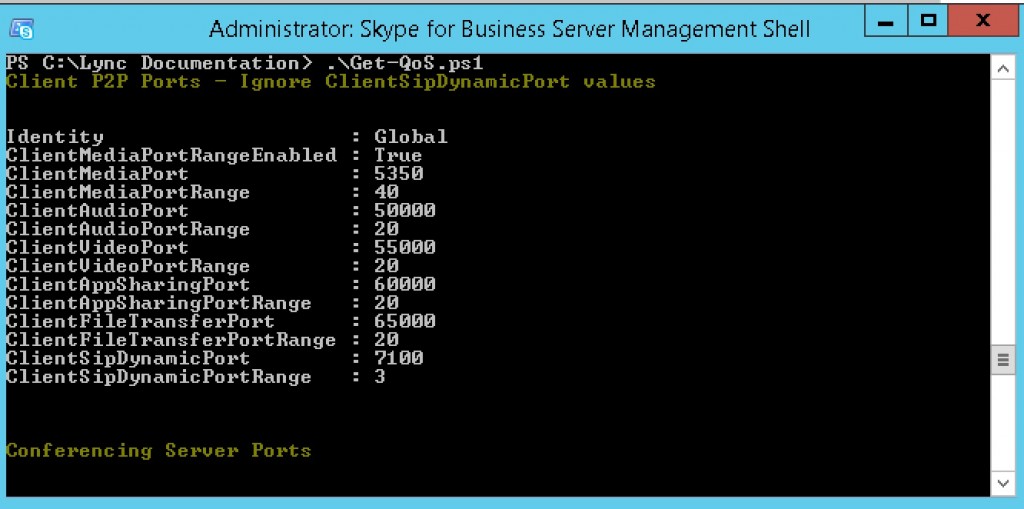
Full output below:
 Client P2P Ports -  Ignore ClientSipDynamicPort/Range and ClientMediaPort/Range values
Identity                    : Global
ClientMediaPortRangeEnabled : True
ClientMediaPort             : 5350
ClientMediaPortRange        : 40
ClientAudioPort             : 50000
ClientAudioPortRange        : 20
ClientVideoPort             : 55000
ClientVideoPortRange        : 20
ClientAppSharingPort        : 60000
ClientAppSharingPortRange   : 20
ClientFileTransferPort      : 65000
ClientFileTransferPortRange : 20
ClientSipDynamicPort        : 7100
ClientSipDynamicPortRange   : 3

Conferencing Server Ports
Identity            : ConferencingServer:FEPOOL.DOMAIN
AppSharingPortStart : 60000
AppSharingPortCount : 5000
AudioPortStart      : 50000
AudioPortCount      : 5000
VideoPortStart      : 55000
VideoPortCount      : 5000

Application Server Ports
Identity            : ApplicationServer:FEPOOL.DOMAIN
AppSharingPortStart : 60000
AppSharingPortCount : 5000
AudioPortStart      : 50000
AudioPortCount      : 5000
VideoPortStart      : 55000
VideoPortCount      : 5000

Mediation Server Ports
Identity       : MediationServer:MEDPOOL.DOMAIN
AudioPortStart : 50000
AudioPortCount : 5000

QOS Enabled
Identity  : Global
EnableQoS : True

Edge Server Ports - Best practice to leave default start port 50,000, count 10,000
Identity                    : EdgeServer:EDGPOOL.DOMAIN
MediaCommunicationPortStart : 50000
MediaCommunicationPortCount : 10000

Web Server Application Server Ports
Identity            : WebServer:FEPOOL.DOMAIN
AppSharingPortStart : 60000
AppSharingPortCount : 5000

Identity            : WebServer:DIRPOOL.DOMAIN
AppSharingPortStart : 60000
AppSharingPortCount : 5000

Lync Phone Edition DSCP Tag
Identity         : Global
VoiceDiffServTag : 46
From the above you can see that the port ranges for all modalities are as follows:
- Audio: 50,000 > 54,999 (50,000 > 50,019 P2P)
- Video: 55,000 > 59,999 (55,000 > 55,019 P2P)
- App Sharing: 60,000 > 64999 (60,000 > 60,019) P2P
- File Transfer: 65,000 > 65,019 (P2P)
Another nice feature of the QoS calculator is aligning the P2P ports with the Server ports.